| Search | Statistics | User Listing | Member Roster | Coach DB | Forums | Albums |

| Home -> FMC Owner's Forum -> General Discussion -> Mechanic's Corner -> View Thread |
| ||
| ||
|
| You are logged in as a guest. ( logon | register ) |
 440-I or 8.1L Vortec w/5spd or 6.6T Duramax w/6spd? 440-I or 8.1L Vortec w/5spd or 6.6T Duramax w/6spd?Jump to page : 1 Now viewing page 1 [25 messages per page] | View previous thread :: View next thread |
| General Discussion -> Mechanic's Corner | Message format |
BigRabbitMan |
| ||
Expert   Location: Cottage Grove, OR | As they say, if it wasn't for bad luck I would't have any at all! Bottom line is that I now need to replace my engine. The question is what do I replace it with? A. A different rebuilt 440-I. B. A used 8.1L GM Vortec with a matched 5 speed Allison. C. A used 6.6L Turbo Duramax diesel with a matched 6 speed Allison. Each of the different paths have advantages and disadvantages. I have a leaning in a certain direction, but I don't want to influence others opinions by taking a stance at this point. I would like to hear others opinions of which path to take, but more important than the conclusion are the reasons why a particular path should be or not be taken. It is those reasons that I will use as input to my final decision which will have to be made before long. All three options must be based on retaining the existing gearing of the differential. The gearing ratios of the Allison's are posted in the file section of the FMCMotorCoach2 Yahoo site. Complexity obviously increases as you move from option A to option C. The cost of A and B aren't that far apart as a used Vortec and trany with wiring harnesses, computers and exhaust system components is about the same cost as a fresh rebuilt 440-I. Installation would be higher with B. Obviously C has the highest cost, but potentially also the greatest benefits. I really need as much of a discussion of the pro's and con's of each as possible so that I can have as much info as possible to make my ultimate decision. If I am going to make a change in configuration, now is when it must be done. I have excluded other engine and transmission options so we can restrict the discussion to the three configurations outlined above. I might say that I already have an Allison 545 installed with my current engine so if option A is selected it includes that transmission. I thank you for taking the time to give this your reasoned thought, | ||
| |||
| MCR |
| ||
Veteran Location: Illinois | Stephen - The best choice for your FMC Coach would be the Diesel w/Allison 1000/2000 transmission. The 5 speed version of the Allison would be less expensive and unless you change the differential to a 5.5 or lower gear ratio the 6 speed would not be an advantage. Now if you do the Diesel/Allison driveline you MUST shearplate the coach structure due to the increased torque at low RPM levels. Without the shearplate the coach superstructure will fail. If I was to stay with the gas engine, I would stay with a QUALITY BUILT I440 engine since that is a known success in the pusher design. The 8.1L should function well - BUT the QUESTION is - "How long will the engine last in the FMC configuration???". All those that I have spoken with that have had other engines (GM and Ford) did not last the 150,000 or more miles like the QUALITY BUILT I440 engines. So, DECISION TIME!!!! HAPPY TRAILS - Leslie and FMC #0938 | ||
| |||
| BigRabbitMan |
| ||
Expert Location: Cottage Grove, OR | The following is a copy of a posting I have made in another forum. It gives others an overall description and a status report. I am reposting it here so all will be informed. ************ | ||
| |||
| MCR |
| ||
Veteran Location: Illinois | Stephen - As usual you have made excellent report. The torque load on the structure can not be avoided for as soon as engine reaches max torque RPM the torque hits the structure. The only question is how many torque applications beforer structural damge becomes apparent. What is HP, Max Torque, and torque curve for engine you have acquired??? Leslie | ||
| |||
| BigRabbitMan |
| ||
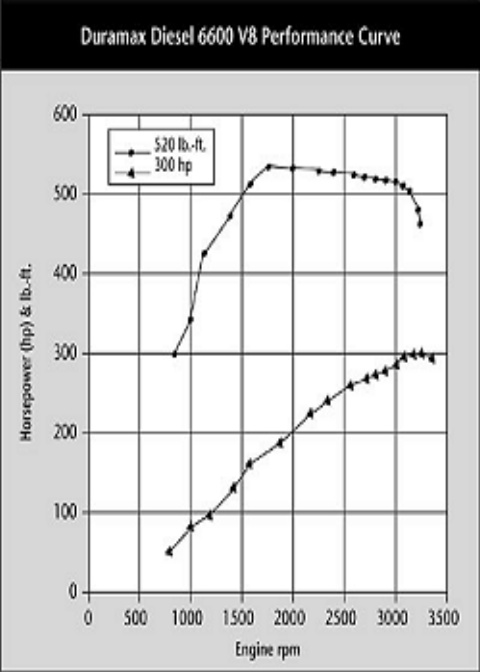
Expert Location: Cottage Grove, OR | Here is a general description of the engine from a TopKick Truck brochure: DURAMAX DIESEL 6.6L V8. For the dependability, fuel efficiency and torque output benefits of adiesel, there™s the Duramax Diesel 6.6L V8. Its advanced durability is the product of features like a deep-skirt block with induction-hardened bores, nitride treated forged steel crankshaft, oil-spray piston cooling and a gear-driven water pump and camshaft. The Duramax Diesel 6.6L V8 is also remarkably quiet, due in part to full electronic fuel injection controls that provide pilot injection capability. Pilot injection first introduces a small amount of fuel into the cylinders, followed by a slight delay before the main pulse of fuel is injected. As a result, the combustion process starts on a smaller scale and builds progressively, for smoother and quieter operation. Max HP is 360hp at 3200 rpm. Max torque is 650 ft.lbs. at 1600 rpm. If I have done it correctly, just above this is the HP and Torque curves for the LB7 Duramax as of 1999 when introduced. If I have not done it correctly, then go to the Album section and see the album named Duramax Note that my engine developes a little more of each, but the pattern would be about the same. By having a relatively flat torque curve (the area between 1500 and 3000 rpm) the transmission can gear down to increase the engine to ground mechanical advantage and increase the rpm and still maintain torque output. This enables downshifting to increase the gear ratio between the engine and the ground when under load which transfers the needed torque to the ground while needing less torque from the engine due to the mechanical advantage achieved with the lower gear. For example, less engine torque is required to climb a hill at the same speed if a coach has 19.5 tires and a 4.62:1 ratio rear end than the same weight coach with 22.5 tires and a 3.90:1 ratio rear end. Leslie, do you have the torque curve as a graph or table for the Detroit 8.2T? | ||
| |||
| BigRabbitMan |
| ||
Expert Location: Cottage Grove, OR | Definition of Torque: In physics, torque (or often called a moment) can informally be thought of as "rotational force" or "angular force" which causes a change in rotational motion. This force is defined by linear force multiplied by a radius. source: Wikipedia.com An illustration is a horizontal wrench attached to a bolt. If a one pound weight is hung on the end of a one foot long wrench, one foot pound of torque is applied. Change the weight to three pounds or the length of the wrench to three feet and three foot pounds of torque is applied. A three foot wrench with a three pound weight then exerts [3X3=9] nine ft.lbs of torque. Now let's apply that concept to two FMC coaches. One has a 1560 lb. Detroit 8.2T diesel installed. The other has an 835 lb. Duramax installed. Furthermore, let us assume that the center of mass of both of the engines is 1.5 ft. to the rear of the attachment point of the engine mounting subframe of the coach. 1560 minus 835 equals a weight difference of 625 lbs. Multiply the differential weight (625) times the length of the lever (1.5 ft.) equals a differential torque force of 937.5 ft.lbs. of torque. This is a constant differential force. Now if the Duramax puts out a maximum torque of 650 ft.lbs. at full throttle, the additional torque applied to the coach is about 2/3 of the differential torque applied to the other coach with the Detroit when it is standing still. In other words, the Detroit equipped coach is under more stress 24 hours a day, 7 days a week, 365 days a year than the Duramax coach is under for the limited amout of time that it is at full throttle. Of course, the Detroit adds an additional 500 ft.lbs. of torque when it is at full throttle! Given these numbers, it is my opinion that the structual requirements that are required for the Detroit are much greater than the requirements for the Duramax and so it is incorrect to apply the requirements of that engine to the Duramax. | ||
| |||
| MCR |
| ||
Veteran Location: Illinois | Stephen - The engine torque applied to the structure of the coach is a factor of that torque available at a given engine RPM. The engine type is irrelevant. Therefore, if the Duramax developes 650 lb-ft of torque above 1600 RPM, then the stucture is hit with the max torque of the engine above 1600 RPM for the Duramax installation. The slope of the torque curve defines the torque available at whatever engine RPM. If the Duramax maintains 650 lb-ft torque from 1600 to 3000 RPM then the structure will be under load across this RPM range. Whereas, the 8.2L Detroit engine developes max torque at 1600 RPM but begins to tail at 2050 RPM. Hence torque load comes above 1600 RPM and below 2050 RPM. The shear plating of the structure would still be the requirement for all diesel installations in the FMC monocoque structure due to the added torque load of the engine. The FMC monocoque structure was defecient with the I440 installation as noted on FMC Coaches with 100,000 miles and more. The rear section of the coach is falling from level when viewed on the drivers side from front to rear along the beltline. The only solution is to straighten structure and shearplate the coach. Therefore, the diesel engine only accentuates an existing defeciency. HAPPY TRAILS - Leslie & FMC #0938 | ||
| |||
| MCR |
| ||
Veteran Location: Illinois | Stephen - I printed your your Duramax Performance curve graph and noticed it was for the 300 hp Duramax. Do you have the graph for the 350 HP - 650 lb-ft version of the Duramax??? If so could you post same??? Leslie | ||
| |||
| Duramaxer |
| ||
Veteran  Location: Oslo Norway | I answer a question on my GMC Duramax truck in this thread since this is the Duramax thread. My truck is a 2001 GMC Sierra 2500 HD. It was converted to heavier spec rear suspension and front snow plow spec front suspension by TriStar in Canada, before import. Conversion was done to pass Norwegian import rules and allow it to be imported tax free with all 5 seats. Trucks over here have normal car tax if more than 3 seats. These laws have now been changed and my truck would now cost more than 200 000 $ !! We have extra tax on weight, horsepower and displacement. Grrrrr...... I have had no problems with my engine except injectors. It has 177 000 Km (110 000 miles) on it. I abuse quite it every day and it has been running on upgraded programming since it was broken in. BUT I have always believed maintenance is everything so I have had more frequent oil and filter changes than normal. Newer engines are not known to have problems with the injectors and there is extended unlimited warranty on the injectors. I really love the engine and the way it performs together with the Allison autotrans. There are not that many heavy US pickups over here but I have yet not been outrunned by any. The engine trans combo feels a little to much when driving empty so I almost prefer pulling a heavy caravan on longer trips. I have pulled back home other peoples trailers from motocross-events. The fuel consumption is almost same with or without a trailer. I would have trusted the Duramax if I ever where to put a diesel in a FMC. Kjetil | ||
| |||
| Duramaxer |
| ||
Veteran Location: Oslo Norway | Stephen, you might have this information but if not here we go: LBZ Powergraph: You can download it and put it in your Duramax album if you like. We do not want any diesel spill in the 477# album you know ;-) http://www.fmcowners.com/mbbs22/photos/show-album.asp?albumid=14&ph... Data on the LBZ and LLY beginning late 05 depending on application. I will only paste GM offical data, that does not meat it is true ;-) But a good start anyway. 360 / 268 @ 3200 rpm (2500 HD and 3500 Chevrolet Silverado and GMC Sierra) (LBZ) (Automatic transmission only) (Available beginning 4 th quarter 2005) 310 / 231 @ 3000 rpm (2500 HD and 3500 Chevrolet Silverado and GMC Sierra) (LLY) (Automatic transmission only) (Available through 3 rd quarter 2005) 300 / 224 @ 3000 rpm 2500 HD and 3500 Chevrolet Silverado and GMC Sierra (LLY) (manual transmission), Chevrolet Kodiak and GMC TopKick (LLY) and Hummer H1 Alpha (LLY) 250 / 186 @ 3200 rpm (Chevrolet Express and GMC Savana) (LLY) Here is the changes and later development. This is a 07 file but changes befor 07 is listed: 2007 DURAMAX DIESEL 6.6L V8 Turbo (LLY, LBZ) FULL DESCRIPTIONS OF NEW OR CHANGED FEATURES LOWER OUTPUT FLEET VERSION DROPPED The lower-output option for fleet versions of the engine that was introduced for the 2003 Model Year has been dropped. OVERVIEW The Duramax Diesel 6.6L V8 provides class-leading output, exclusive durability enhancing features and superior noise and vibration control for GM’s heavy-duty pickups, commercial vans, and medium-duty trucks. This 90-degree turbodiesel V8 combines the best design and manufacturing elements of General Motors Powertrain worldwide. With vast experience in a wide range of climate conditions, driving cycles and ownership demands, GM Powertrain is responsible for engine control systems and electronics. The Duramax Diesel 6.6L V8’s compact, exceptionally rigid cast-iron engine block provides the foundation for smooth, low-noise operation. It features induction hardened cylinder bores – a technique borrowed from larger diesel engines and exclusive in the pickup class – and four-bolt, crossed-drilled bearing caps. A die-cast aluminum lower crankcase strengthens the engine block and serves as the lower engine cover, keeping weight to a minimum. The forged steel crankshaft is surface-hardened by nitriding – a process widely viewed as the most effective means of limiting wear and assuring durability. Aluminum pistons minimize reciprocating mass and improve efficiency. Each has a small hole cast in its skirt, allowing jets to spray cooling oil through a cast channel and up toward the bottom of the piston bowl, where most heat is generated. Aluminum cylinder heads deliver strength greater than or equal to cast iron with considerably less weight. The Duramax also has four valves per cylinder – the standard for contemporary luxury-car diesels – and an integrated oil cooler. Several features make it easier to service. Its compact size leaves more space around the engine when it’s installed in the vehicle. The timing gears are at the front of the engine for easy access, and in heavy-duty pickups, the customer can remove the fuel filter simply by leaning into the engine compartment. The Duramax Diesel 6.6L V8 operates on the direct injection principle which, other things equal, allows more complete combustion than the older style indirect injection and decreases specific fuel consumption as much as 20 percent. Each state-of-the-art high-pressure injector has its own solenoid to manage fuel spray, the latest injectors featuring six spray points in each injector tip for better fuel vaporization. The solenoid-type injectors reduce the amount of fuel leakage between pulses. They allow more precise fuel control, with more consistent performance under hot-fuel conditions, and greatly reduce the potential for clogging due to fuel contamination. The injectors are installed directly into the head and are coded so that the E35 ECM can precisely match the flow characteristics of each injector on a particular engine to compensate for small variations, ensuring exact fuel delivery. For the 2006 Model Year, a new fuel pump increased fuel pressure from 23,000 psi (roughly 300 times greater pressure than the typical gasoline injection system) to 26,000 psi, and the fuel lines and rails have been strengthened for the higher pressure. Also in 2006, the compression ratio was lowered from 17.5:1 to 16.8:1 to improve the operating smoothness of the engine. As continuing development aimed at lowering diesel emissions progressed, the exhaust gas recirculation (EGR) system was enlarged for the 2006 Model Year and installed in all Duramax Diesel 6.6L V8s. The EGR system recycles some exhaust gas back into the intake stream to cool combustion and reduce oxides of nitrogen (NOx) emissions. The Duramax Diesel 6.6L V8 system features a unique cooling process that increases its effectiveness. Hardware required includes: plumbing that carries some exhaust gas from the turbocharger to the intake, an EGR control valve and a stainless steel cooling element. The EGR valve is managed by the E35 ECM. The EGR cooling element bolts to the right side of the engine, on the inboard side of the cylinder head, with jackets fed by engine coolant. Returned exhaust gas passes through a spiraled passage in the element, and the temperature of the gas is lowered before it returns to the combustion chamber. The current E35 ECM was adopted for the 2006 Model Year, and to take advantage of its greater processing power, revised control strategies were installed which allow faster starting and reduced cold-cranking times. The Duramax Diesel 6.6L V8 was launched in the Chevrolet Silverado and GMC Sierra 2500HD and 3500 Series trucks with Allison automatic transmissions in 2001. Application expanded to the Chevrolet Kodiak and GMC Topkick medium-duty trucks for 2003, with 16,000, 18,000 and 19,500-pound gross vehicle weight ratings (GVWR). World-class diesel engines such as the Duramax Diesel 6.6L V8 share two key characteristics: incredible torque to tow or haul loads, and higher-rev horsepower for smooth, flexible over-highway travel. A turbocharger increases power by pumping additional compressed air into the engine’s combustion chambers, in turn allowing a greater quantity of fuel to combust at the optimal oxygen/fuel ratio. In a conventional turbo, the turbine spins as exhaust gas flows out of the engine and over the turbine’s blades, concurrently spinning a compressor wheel at the opposite end of the turbine shaft and pumping more air into the intake system. The turbine blades are fixed, and the amount of boost pressure is in a sense static, varied only by how fast the turbine spins as exhaust gas flows from the engine: The faster the engine operates, the more exhaust pressure and the higher the turbo boost pressure. Typically, maximum boost pressure is controlled by a wastegate, or a release valve that bleeds off excess pressure when boost reaches a prescribed level. Refinements in 2005 included an overall reduction in exhaust emissions and an increase in torque output, which was enabled by significant hardware changes in 2004. Those changes included a new variable-geometry turbocharger. Self-adjusting turbine vanes and sophisticated electronic controls automatically adjust boost pressure and exhaust backpressure. The vanes direct exhaust gas at the turbocharger’s turbine blades. These vanes can be opened and or closed to vary the amount of boost pressure. An electro-hydraulic device operated with engine oil, similar in concept to a camshaft phaser, adjusts the turbine vane angle. The variable-geometry turbo has its own sensors managed by the engine control module (ECM). A solenoid controls oil pressure against a piston that operates a small cam, which works on a unison ring that moves the turbine vanes simultaneously. As the cam turns, it varies the angle of the blades relative to the turbine wheel. The crucial advantage: With the moveable blades, boost pressure can be controlled independent of engine speed. The variable-geometry turbo presents a number of benefits over the conventional fixed-geometry type. Boost can be controlled more precisely, with a greater range of modulation, than with a fixed-blade turbine. The Duramax Diesel 6.6L V8’s turbo eliminates the need for a wastegate, which is often the first turbocharger component to fail as mileage accumulates. Because the variable-geometry turbo can essentially change resistance and adjust the amount of exhaust backpressure, it also eliminates a separate exhaust pressure regulator, which was previously used to manage engine or compression braking. Maximum boost in the Duramax Diesel 6.6L V8 remains 20 psi. Yet boost pressure can be varied more subtly over the engine’s rpm range. This presents itself to the customer as more immediate engine response, with virtually no turbo “lag.” Equally important, the ECM measures a number of parameters, from operating temperature to engine speed to fuel injection timing to load demands, when managing the turbine vanes and controlling boost, so the turbocharger operates more efficiently in all conditions. Combined with improvements to the fuel system, the variable-geometry turbocharger allows the Duramax Diesel 6.6L V8 to deliver more power with lower exhaust emissions and no decrease in overall fuel efficiency. Late in the 2006 Model Year, structural changes to the block and connecting rods increased the strength of the engine, which allowed calibration changes that increased output for the applications in the Chevrolet Silverado and GMC Sierra pickups to the current horsepower and torque levels (see specifications). The Duramax Diesel 6.6L V8 is equipped with two-piece rocker covers that accommodate external connections for the fuel lines and new fuel injectors. These resemble conventional rocker covers, but they are split lengthwise along the plane of the top surface of the cylinder head. The lower, rectangular piece of the rocker cover rings the perimeter of the cylinder head and bolts to the head like a conventional cover. The upper portion of the rocker cover attaches to the lower piece. The new two-piece rocker covers ease access to the fuel rails and injectors. Previously, the rocker covers and then the fuel lines had to be removed in order to reach the fuel injectors. The top piece of the new rocker cover is scalloped on its lower edge, around the point where the injectors fit into the cylinder heads. The injectors are now exposed on the engine, and can be removed with no other disassembly required. Such serviceability considerations are particularly significant in an engine like the Duramax Diesel 6.6L V8, with an anticipated useful life beyond 200,000 miles. Fast-heating glow plugs reduce pre-start heating time without increasing draw on the battery. All diesel engines are equipped with glow plugs – essentially heating elements that pre-heat the combustion chambers to sufficient temperature for compression ignition. The Duramax Diesel 6.6L V8’s glow plugs draw 6.6 watts of electricity, as before, but the element has been redesigned to more efficiently convert electricity to heat. Moreover, the glow-plug controller is specifically calibrated for the Duramax Diesel 6.6L V8’s new engine control module and allows pulse width modulation, which manages current more like a rheostat than an on-off switch. I do not know enough about these variations in practice but I would be concerned taking the engine from one donor truck and the electronics from another, but some serious investigation will minimize the risk of making mistakes. I some experience of modern Volvo marine diesel engines and I can not be to clear about the importance of doing the cablework right. Things will get very messy if you end up with poor connectors, ground loops and variables in the cablework. Diagnosis system will be no good then and in some cases even make things more difficult to sort out. I am sure you will work it all out, and end up with a very well powered and reliable coach. Kjetil Edited by Duramaxer 2007-09-07 4:12 PM | ||
| |||
| BigRabbitMan |
| ||
Expert Location: Cottage Grove, OR | Kjetil, Thank you for posting the power curve chart for the LBZ. I had been looking for it and was unable to find it. Now Leslie can print that one as well. I will repost it in my album so that you can keep it from "spilling diesel" in #477's album!!! I have the information you posted above, but I am glad you posted it here so that others can see it as well. That description as well as the information and observations I have seen in the the course of visiting a number of other diesel related sites and talking diredtly to Duramax owners is what convinced me that the Duramax is the only diesel to consider at this point in time and that of the Duramax models the LBZ is the most desirable if one can be located at a reasonable price. Other Duramax models will aslo perform very well. I feel I was able to secure an LBZ at an attractive price just by luck. As you describe, that is the easy part and just the beginning. Kjetil, as you have correctly pointed out, securing all of the correct control systems and properly cabling the system is critical to sucess. That is why the actual conversion of the coach itself won't start until at least a year from now. I expect that it will take that long or longer to first secure the needed compatible componedts and then, secondly, ensure that all cabling questions are answered prior to even starting the installaion. Then, again as you stated, the execution of the installation must be done very correctly. Computerized systems are very sensitive to all wiring issues. I will have to be very particular about the source and compatibility of the ECM and TCM and associated sensors, cables, etc.. I was unable to get the ECM for the engine I got, but it did include the injector control module. I am going to make every effort possible to obtain an ECM and TCM from the same vehicle so that those two critical control units are programed to work with each other. I feel that other sensors and control units are more able to come from variable sources so long as compatible units are used. The compatibility aspect of each unit/sensor will have to be verified prior to installation starting. I recognize that this will be a large, long undertaking. Understanding this, I have had the damaged 440-I replaced with another rebuilt 440-I so that I can enjoy the coach while I am gathering all of the parts and information needed to do a proper conversion. When engines and transmissions moved from mechanical/hydraulic control systems to computerized systems the complexity of any conversoion increased many times over. But it also has increased the possible rewards! | ||
| |||
| MCR |
| ||
Veteran Location: Illinois | Stephen - With the torque curve you have posted the DURAMAX LBZ will run 60 mph at 2100 rpm with the Allison 0.71 overdrive ratio of the 5 speed 1000/2000 transmission, the std.4.625 ratio differential, and 8R19.5 Michelin Tires. If the 6 speed 1000/2000 Allison is used, then in 6th the engine RPM would be 1900 at 60 MPH if the .65 gearing is in place for the 6th speed. One can downshift and maintain highway speed on all but the steepest grades. This powertrain will be excellent for speed, economy, and gradeability. The only hurtle will be to make the installation affordable. BUT - What Price Glory!!! Thanks for your time. HAPPY TRAILS - Leslie & FMC #0938 | ||
| |||
| Duramaxer |
| ||
Veteran Location: Oslo Norway | Stephen This guys might be able to come up with a electric shift kit to control your Allison. http://www.retrotekspeed.com/products/smart-shift/smart-shift-stand-alone/ You can have F1 style padlles behind your steering wheel!!! Kjetil | ||
| |||
| BigRabbitMan |
| ||
Expert Location: Cottage Grove, OR | Thank you for the link. I have saved it for future reference. | ||
| |||
| Jump to page : 1 Now viewing page 1 [25 messages per page] |
| Search this forum Printer friendly version E-mail a link to this thread |
 | Running MegaBBS ASP Forum Software © 2002-2026 PD9 Software | (Delete all cookies set by this site) |